Pliny the Elder tells a story about a shepherd named Magnes. He was driving his herds across the slopes of Mount Ida when the ground grabbed hold of him. The iron nails in his sandals clung to the rock beneath his feet, and the iron tip of his staff held fast to the stones. Pliny had the story from an older writer, Nicander, and it was probably old even then. Magnes had walked onto a field of lodestone, the naturally magnetic ore, and in one telling of the tale the stone took his name.
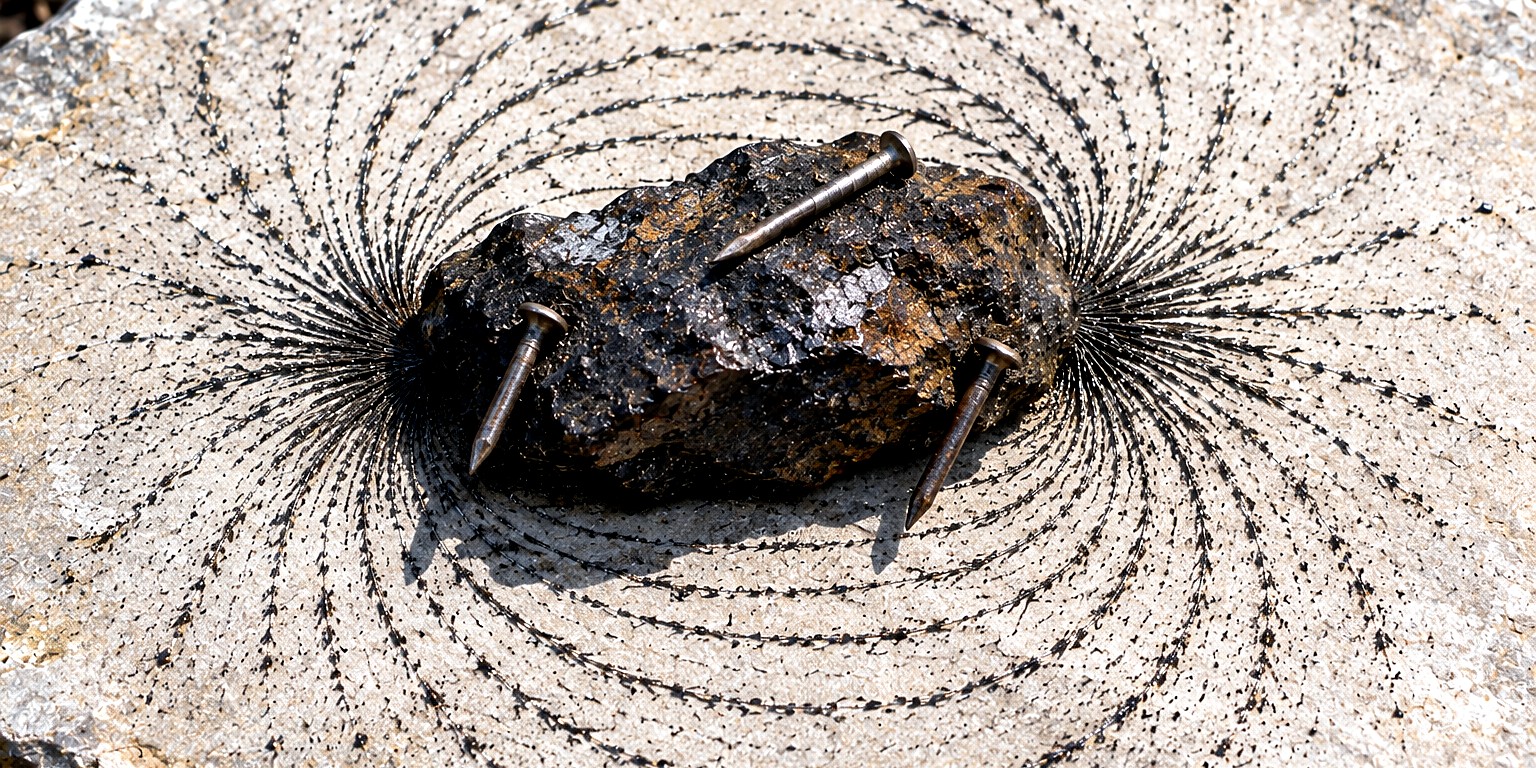
The Greeks never stopped wondering about it. A lump of rock, inert by every other measure, reached across empty space and moved iron, and it did so repeatedly without weakening. Aristotle reports that Thales, often counted as the first Greek philosopher, said the magnet has a soul in it because it moves the iron. Two thousand years later the wonder had not faded. William Gilbert, the English physician who showed in 1600 that the Earth itself is a great magnet, titled one chapter of his book with the claim that magnetic force is animate, or imitates life.
I thought of Magnes recently while listening to the biologist Rupert Sheldrake in a podcast conversation. Sheldrake has a favorite demonstration, and it brings the old wonder back. He uses a Galton board, a flat panel studded with rows of pegs, with a reservoir of small steel balls at one end. Tip the board, and the balls tumble down through the pegs, deflecting to the left or right at every row, and collect in a line of slots at the bottom. Most land near the middle and a few reach the edges. The pile they make is the bell curve, the shape of chance, and it comes out a little differently each time. Then Sheldrake laid a pair of ordinary magnets on the board and ran it again. The balls drifted toward the magnets as they fell, and the pile came out lopsided. An invisible field had bent the shape of chance.
What caught my attention was the point he drew from it. The magnet, he said, spends nothing. Run the board a thousand times and the magnet does not weaken. A field of this kind acts through form, by shaping what happens, without the normal expense of a push or a pull. Sheldrake connects this to Aristotle’s four causes. For a marble statue there is the marble itself, the chisel that strikes it, the image of the figure in the sculptor’s mind, and the purpose the statue will serve. Modern science, he observes, kept the marble and the chisel and grew uneasy with the image and the purpose. His question is one that anyone who studies the natural world eventually meets. If force and matter tell only part of the story, where does form come from?
It is a question my own field answers every day, often without noticing that it has asked it. Start with the magnet itself, because it keeps careful accounts. A ball some distance from the magnet has a small store of energy available to it, the way a rock perched on a ledge does, and as the ball falls toward the magnet it draws on that store and speeds up. When Sheldrake tips the board back and the balls are lifted into the reservoir, away from the magnet, the store is refilled. The balls borrow and repay, and the magnet never runs down because nothing of its own is ever spent. Energy still does all the moving, and the magnet decides where the moving goes. What a magnet holds is an arrangement. In a lodestone that arrangement is the alignment of countless tiny magnetic regions inside its crystals, set in place long ago, often by a strike of lightning. The lightning’s energy was gone in an instant, but the order it left behind has been acting on iron ever since.
That pattern, energy passing through while form stays put, turns up in many places. Sunlight crossing the atmosphere is sorted on its way to the ground. Ozone high in the stratosphere absorbs nearly all the shortest ultraviolet light. Water vapor soaks up bands of the infrared light. The air scatters blue light more strongly than red, which is why the daytime sky is blue. On the way back out, water vapor and carbon dioxide trap much of the infrared that the warmed ground sends toward space, leading to the greenhouse effect. The atmosphere manages all of this because it is a mixture of gases whose molecules have specific shapes, and the shapes do the sorting. The energy arrives with the sunlight. What the air contributes is form.
A seed crystal does something similar. Anyone who has made rock candy has seen it. A jar of syrup can hold more dissolved sugar than it can keep dissolved for long, and it may sit unchanged for days until a small crystal is lowered into it. Then the sugar begins to come out of solution and build on the seed, layer by layer, in the seed’s own pattern. The seed supplies none of the energy released as the crystal grows. It spares the sugar the hard first step of starting a crystal from scratch, and it offers a pattern for the molecules to settle into. Catalysts play the same part in chemistry, changing how fast a reaction runs without changing the reaction itself. The cells of your body run on thousands of them.
A very general case we can consider is a landscape. Roll a marble around the inside of a bowl and it comes to rest at the bottom. Gravity drives the marble, friction slowly drains its motion, and the bowl’s shape decides where that motion leads. The bowl adds no energy to the marble anywhere along its path, and yet it fully determines where the marble ends up.
As a structural geologist, I find this idea central to my view of the world. When I look at a deformed rock, I read the symmetry of its fabric, the way its grains and layers have been drawn into alignment, and from that shape I can infer the motion that produced it, sometimes across hundreds of millions of years. The energy that deformed the rock is long gone. The form remains and provides the record. Aristotle’s formal cause stayed in science. It moved into the language of shapes, constraints, and boundaries, and those of us who read rocks for a living rely on it.
Minds work this way too, and this is where Sheldrake’s question meets my own. The framework I have been developing treats a mind as the inside of a particular kind of system, one that filters its world, models its own filtering, and has something at stake in how that filtering goes. Filtering is formative cause in Aristotle’s sense. Like the atmosphere sorting sunlight, a mind shapes what reaches it without supplying what reaches it. Its experience, in my framework, is simply motion through a dynamical landscape. There are valleys it settles into, which are its habits and moods and familiar ways of being. There are ridges between those valleys, and the higher the ridge, the harder it is to leave one way of being for another. A person whose life has worn a deep valley of fear returns to fear the way the marble returns to the bottom of the bowl, and the shape of the terrain does the deciding.
Near the end of the conversation, Sheldrake wondered whether free will might work like his demonstration, with the mind biasing otherwise random processes in the brain the way his magnets biased the falling balls. He added, almost in passing, that it was his own choice where to put the magnets. I return to that remark, because it holds a question I care about. In a mind, who places the “magnets”?
My answer is that the system places its own. Many natural systems have slow variables and fast ones. The slow ones, such as accumulated history, settled habits, and what the system has at stake, shape the terrain, and the fast ones run through it. When a system sits near a ridge, where two outcomes are nearly balanced, a very small push can send it one way or the other, and the closer it sits to the ridge, the smaller that push needs to be. The push can come from the system’s own slow variables, from what it has lived through and what it cares about. In the dynamical model of psychological change I have been building, a slowly gathering pressure reshapes the terrain on which faster activity runs, and that activity in turn spends down the pressure. A version of it runs at innerattractors.com for anyone who wants to watch. The magnets are placed from within, by the system’s history, and the history is written into the terrain. A lodestone carries an order laid down by its past and can do nothing to change it. A mind can do more. It can model parts of its own organization, feel what that organization costs it, and over time reshape the terrain that will shape its future.
Sheldrake has his own answer to where the memory of form is kept. He proposes that it lives in fields that reach across space and time, so that an oak seedling grows by resonating with the oaks before it and a young spider spins its first web by tuning in to the webs of earlier spiders. My work points to a nearer address. Rivers cutting through the same kind of rock carve canyons that look alike, though no canyon was waiting for any of them in advance, because the same material yields to the same process in the same way. In my framework, a system’s history lives in its own organization, in the shape of its own terrain. Sheldrake has said that what matters most is evidence, and on that we agree. Organization kept locally, in the shape of a system’s own terrain, is already well documented across physics, chemistry, and biology, while fields that carry memory across time are still waiting for the kind of evidence Sheldrake himself asks for. My framework also makes claims that need testing.
Sheldrake’s distinction between energy and form leads to another part of his demonstration that I like. A human brain runs on about twenty watts, roughly the power of a dim light bulb, and all that energy is borrowed. It comes from food, and the food came, by one route or another, from sunlight caught by plants. The brain spends what it borrows and must borrow again, the way the balls on Sheldrake’s board draw down their small store of energy and have it refilled each time the board is reset. An oil lamp is the same. Its oil came from olives that ripened in the sun, or from ancient sunlight pumped out of the ground as petroleum, and its flame spends what the sun delivered long ago.
The flame also has a shape, and the shape belongs to the lamp. The wick, the reservoir, the draft of air through the chimney, and the chemistry of the oil determine whether the flame stands steady and clean, or smokes and gutters. A whirlpool in a river is like this. The energy belongs to the moving water, and the whirlpool is the shape the flow takes in that specific place. Change the riverbed and the whirlpool is gone, and nothing from outside the system leaves with it, because the whirlpool was never a second thing added to the water.
The energy a mind borrows can be measured. It is counted in calories, conserved at every step, and traced along a known path from the sun to the plant to the dining experience to the nerve cell. What a mind does with that energy is its own. The filtering, the modeling, the stakes, the valleys and ridges worn by a lifetime, are the shape the borrowed energy takes as it passes through, and in my framework, that organization, met from the inside, is the light of experience itself. The energy is on loan. The light is the lamp’s own.
Thales looked at the lodestone moving iron and concluded that there was a soul in it. He was looking at something that acts without effort and asking what thing was doing the acting. The answer turned out to be the stone’s form, an order of tiny magnets laid down in its crystals, perhaps by a flash of lightning, long ago. Twenty-six centuries later we can say something similar about ourselves, with one difference the stone never had. A mind’s form is lit from within. When Magnes felt the mountain take hold of his sandals, he was feeling the pull of an order the stone had kept for ages without spending any of it. What holds us, shapes us, and steadies us is an order of that kind too, built by our own history and kept by our own stakes, and the light by which we meet the world is the shape that order gives to the energy passing through.