In the beginning, there was nothing.
That sentence, in some form, opens almost every serious attempt humanity has made to describe the origin of things. The Hebrew scriptures place darkness upon the face of the deep before creation begins. In Hesiod's Theogony, the earliest Greek cosmogony we possess, the universe begins with Chaos: a gaping, undifferentiated chasm from which the first things emerge. Norse mythology describes Ginnungagap, the yawning void that existed before the world, silent between the realm of primordial ice and the realm of fire, before the dynamic between them began. Hindu cosmology describes the stillness before Nataraja begins to dance. The Tao Te Ching opens: before heaven and earth there was something formless and complete.
These traditions are separated by geography, language, centuries, and completely different intellectual frameworks; none were borrowed from the others. And yet they all begin in the same place: the void. Pure potential, no differentiation, no movement, no opposing poles. Just the groundless ground from which something stirs.
This convergence is not a coincidence of poetic convention. Every one of these traditions also recognized what comes next: from the void, a dynamic arises, and what the dynamic generates is a pair of complementary states in perpetual transformation. Darkness and light. Ice and fire. Yin and yang. The void does not simply become something. It becomes a living process organized around two wings.
The Same Century
Around 500 BCE, in an Ionian port city on the western coast of what is now Turkey, a philosopher named Heraclitus was writing things down that almost nobody agreed with. His contemporaries found him obscure to the point of arrogance. Later biographers called him the weeping philosopher. His single book — later writers called it On Nature — was deposited in the temple of Artemis at Ephesus and is now entirely lost. We have only fragments, quoted by writers who came after him, often with agendas of their own, and scholars debate whether those quotations accurately represent what he actually wrote.
What survives is one of the most striking sets of observations in the history of Western thought. Heraclitus' concept that everything flows captures the spirit, if not the exact words, of what the fragments preserve. Change is the only constant. The universe does not tend toward stillness but toward perpetual transformation between complementary states. Hot becomes cold, day becomes night, the road up and the road down are the same road. Opposites are not enemies but partners in a living process. The tension between them — like the tension in a bent bow or a plucked string — is what holds things together and keeps them moving.
He was describing, without those words and without knowledge of China, what Laozi and the early Taoist tradition were articulating on the other side of the Eurasian continent in roughly the same era.
The German philosopher Karl Jaspers, writing in 1949, named the period in which this happened: the Axial Age. Between roughly 800 and 200 BCE, he observed, civilizations across the globe — China, India, Persia, the Levant, Greece — underwent profound and apparently independent transformations in thought. Confucius and Laozi in China. The authors of the Upanishads and the Buddha in India. The Hebrew prophets. Zoroaster in Persia. In Greece, the pre-Socratic philosophers including Heraclitus and Pythagoras, and eventually Plato. These figures did not know about each other. They were working separately, in different languages, from different starting points, and they kept arriving at similar places.
The void, the dynamic, the two complementary wings — each tradition had its own language for it, and none had borrowed from the others.
The Fork
Then the West made a choice.
Plato, working in Athens in the 4th century BCE, used Heraclitean flux as a foil. Because sensible things are always changing, Plato argued, there can be no reliable knowledge of them. True knowledge requires stable objects. His answer was the theory of Forms — eternal, unchanging archetypes of which ordinary things are imperfect copies. The flux is real, but it is the wrong level of reality. Look past it to the Forms and you find what actually endures.
This move proved enormously productive. It gave Western thought formal logic, mathematics as a discipline of eternal truths, and eventually the entire scaffolding of Western science through Aristotle, the Stoics, medieval scholasticism, Descartes, and Newton. The great arc from Plato to Newton to the 19th century was built on the premise that beneath the flux of appearances lie fixed and knowable structures.
Heraclitus became a footnote. The process-oriented, flux-embracing, paradox-comfortable mode of inquiry he embodied had no home in the mainstream of Western thought. The Eastern traditions never made Plato's turn. Yin and yang, qi, the Tao — these are not static essences but rather descriptions of how things move and transform. The philosophy built around them was not embarrassed by flux or paradox, but was organized around them.
Two roads, running briefly parallel during the Axial Age, then diverging. The West committed to form, stability, and knowable law. The East stayed with flow, transformation, and the void at the foundation of everything. For roughly two and a half thousand years they ran in different directions, asking different questions, producing different kinds of knowledge. That commitment to Form over flux generated extraordinary results: formal logic, the experimental method, Newton's mechanics, and the foundations of classical physics. It also had a cost that only became visible when the method reached its limits.
The Western Road
By the late 19th century the Western scientific program had achieved extraordinary things, and yet at its edges certain problems refused to close.
In 1885, King Oscar II of Sweden announced a mathematics competition: prove that the solar system is stable. Henri Poincaré, a French mathematician, entered. His approach was so impressive he was awarded the prize before the paper was fully checked. Then, during review, an error was found. When Poincaré investigated, he discovered something his mathematics had not prepared him for. In the three-body case — just three masses interacting gravitationally — there were orbits that were not periodic, not closed, and that could not be predicted far into the future. The problem was not an error in his calculations. It was a genuine property of the system. Some configurations of even very simple dynamical systems produced behavior that was bounded but unpredictable.
But he had no computer to visualize what these orbits looked like, no framework to describe the geometric object they were tracing through phase space. His results were published, recognized as important, and largely set aside. The mathematics was ahead of the tools needed to develop it. For the next sixty years, the tradition of dynamical systems mathematics continued with the development of Lyapunov's stability theory and Birkhoff's qualitative dynamics, while the strange territory that Poincaré had uncovered remained largely unexplored.
The Accident
In 1960, a meteorologist at MIT named Edward Lorenz was running a simplified model of atmospheric convection on a Royal McBee LGP-30 tabletop computer. In 1961 he wanted to re-examine a particular simulation. To save time, he restarted it midway through, entering the state values from a printed readout. The printout showed 0.506. The computer had been storing 0.506127. Less than one part in a thousand difference.
Within a simulated month the two runs had diverged completely. Lorenz spent two years working out why. The paper he published in 1963, "Deterministic Nonperiodic Flow," was his attempt to characterize the behavior precisely. The word chaos appears nowhere in the paper. He was describing something that had no name yet.
When the trajectory of his model was rendered in three dimensions, it traced a shape through phase space: two looping regions connected at a narrow crossing zone. The system orbited one region, approached the waist between them, crossed, orbited the other, crossed back, in a sequence that was bounded, deterministic, and never exactly repeating. The shape it carved looked like a butterfly, or two spirals joined at a center.
The specific shape was not the goal. Lorenz was investigating a rounding error in a weather simulation, following the Western scientific tradition of empirical investigation and building on the mathematical foundations Poincaré had laid seventy years earlier. The shape emerged from the equations before anyone understood what it was.
The Picture
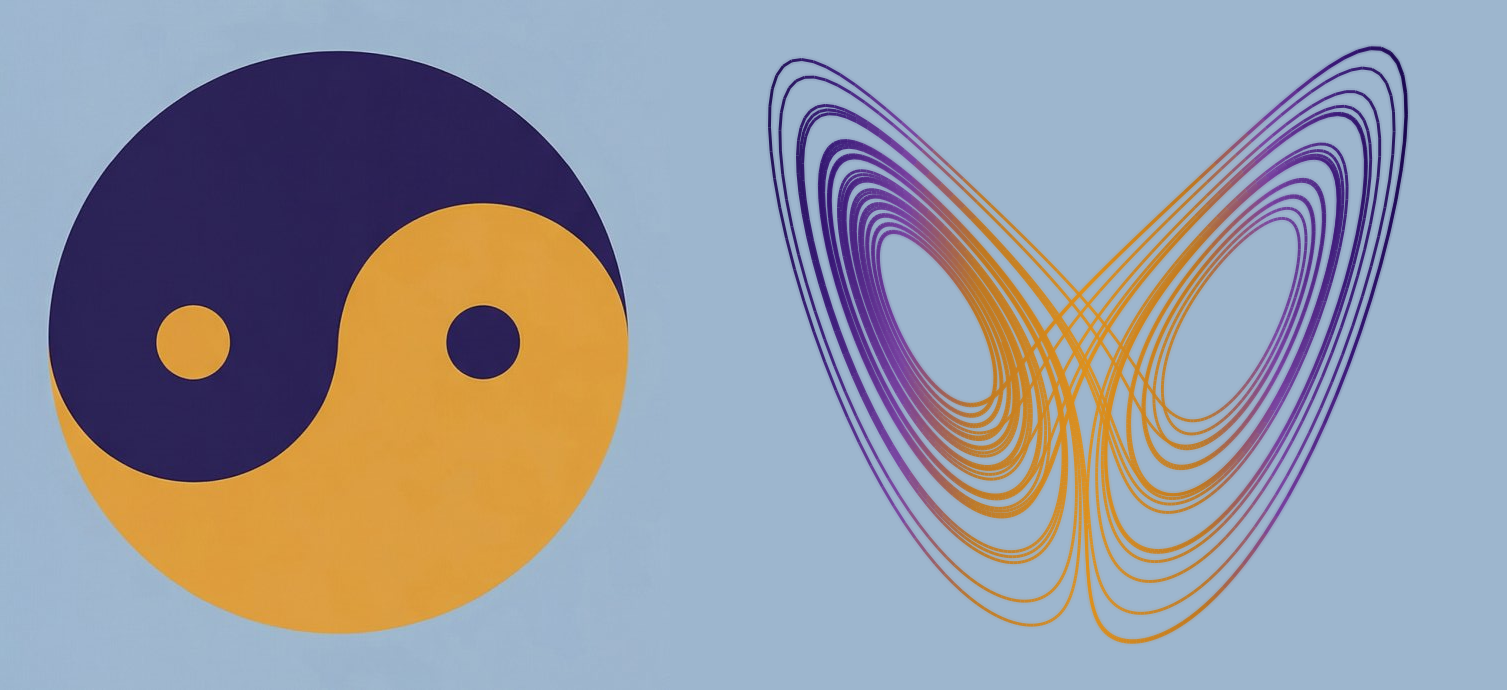
Look at the two images side by side before reading further. The recognition arrives before any analysis.
Two looping regions of opposite character curving around each other. A spiral geometry within each lobe, tightening toward the center before swinging wide, tracing the same S-shaped boundary between the halves that Zhou Dunyi drew. A narrow crossing zone at the center that both images organize themselves around. And in each half of the Taijitu, a small dot of the opposite color that encodes what the attractor geometry makes mathematically explicit: even deep in one wing, the trajectory carries within it the conditions that will eventually pull it across to the other.
Neither tradition privileged one wing. The Lorenz equations are perfectly symmetric: the transformation that maps the trajectory from one wing to the other leaves the mathematics unchanged. The Taijitu encodes the same symmetry. Neither yin nor yang is the correct state. Neither is the destination. The dynamic between them is the form that living systems take.
Three Levels
The visual resemblance between the Taijitu and the Lorenz butterfly is the beginning of the argument, not its end. What makes the convergence genuinely striking is that the Taoist tradition did not describe the dynamic in two levels but in three — and the Lorenz system has all three.
The first level is Wuji (無極): the undifferentiated void before yin and yang have emerged. The primordial ground. Pure potential with no distinctions yet made. In the Lorenz system, this is the origin at the fixed point at x=0, y=0, z=0. Mathematically it is a solution to the equations: if the system were exactly there, it would remain. But it is an unstable fixed point. Any trajectory that approaches the origin is pushed away onto one wing or the other. The mathematics will not let the system stay there.
The second level is Taiji (太極): the Supreme Ultimate, the dynamic itself — the living process of transformation from which yin and yang emerge and between which they move. Taiji is not either wing. It is the structure that organizes the motion, the attractor as a whole. In the Lorenz system this is the strange attractor itself: the bounded, aperiodic, ceaselessly active geometric object that all trajectories are drawn toward. It is not a fixed point or a settled orbit. It is the living form of the dynamic — the shape the system carves through all possible states, persistent without ever repeating.
The third level is yin and yang: the two complementary organized states the dynamic generates. In the Lorenz system these are the two wings, the two lobes the trajectory visits, neither permanent, neither absolute, each carrying within its geometry the conditions that will eventually pull it across to the other.
Wuji, Taiji, yin and yang. Zhou Dunyi's own formulation is characteristically paradoxical when he writes of wuji and taiji as closely fused rather than cleanly sequential, but the directional logic is clear: from the undifferentiated, through the dynamic, into the two wings. This framework, among the most carefully articulated cosmological architectures in the philosophical record, maps beautifully onto the mathematical structure of a simplified atmospheric convection model. The Taoists arrived there through sustained inquiry into how things move and transform. Lorenz arrived there through a rounding error.
This is also where the opening image of the void gains its full meaning across traditions. The unstable fixed point at the origin is the Wuji of the Taoists. It is the darkness upon the face of the deep before the first creative act. It is the absolute stillness from which Nataraja's dance emerges at Chidambaram. It is the Ginnungagap before ice and fire met and the dynamic began. The mathematics doesn't name it. But it places it exactly where every wisdom tradition placed it — at the origin, unstable, generative, impossible to inhabit.
What the Convergence Means
It would be easy to frame this as science finally catching up to ancient wisdom. That framing is wrong in both directions. It makes the Taoist tradition into a precursor waiting for validation, and it misrepresents what Lorenz did, which was not to rediscover something forgotten but to follow the internal logic of a mathematical tradition that had been developing for centuries until it produced a picture nobody had anticipated.
The more honest framing is this: multiple independent civilizational projects, using radically different methods and separated by thousands of years of development, kept arriving at the same three-level structure. The void, the dynamic, the two complementary poles. This structure is too specific to be a universal human metaphor. The three levels are not interchangeable; Wuji is not yin, and Taiji is not yang. The architecture has a precise internal logic, and that precise internal logic keeps appearing.
The most natural conclusion is that the structure is real; that it belongs to the territory and not to any particular map. That complex systems with two organized states, when examined with sufficient seriousness and without prejudging the answer, actually behave this way. An unstable ground state from which the dynamic departs. A bounded, aperiodic, ceaselessly transforming motion that organizes itself around that unstable center. Two complementary poles, neither absolute, neither the destination, each carrying within it the seed of what will eventually replace it.
The practical implication runs against the dominant Western assumption that equilibrium is the goal — that balance is the healthy endpoint, stability the mark of a well-functioning system. What the origin tells you is different. Perfect undifferentiated equilibrium is the state from which all dynamics depart and to which nothing returns. It is not the destination. It is the groundless ground before the dance begins. The wisdom traditions that started in the void, and the mathematics that arrived there through a completely different road, say the same thing: what comes after the void is not a return to it, but a living, bounded, never-repeating movement between the two organized states the void generates when it stirs.
The dance is the form. The stillness is the origin, not the destination.
Ahead of the Picture
Around 500 BCE, in Ephesus, Heraclitus wrote that most people live as if they had their own private understanding of the Logos — the underlying organizing principle of the universe — while the Logos itself is common to all things.
He was describing what the Taoists called the Tao. What the Norse called the dynamic between Niflheim and Muspelheim in the void of Ginnungagap. What the Hebrew tradition placed before light and land and living things. What Hindu cosmology found in the stillness from which Nataraja's dance emerges. And what a meteorologist in Massachusetts found in 1963 when he investigated why a rounding error had made his weather simulation diverge.
None of them were looking for each other, or knew the others were looking. They were all looking at the same thing. Heraclitus deposited his observations in a temple and watched his contemporaries ignore them. His book is gone. What survives suggests he knew, which is usually how it goes.